
Client Exports
OpenComputer
Open a computer from another resource: a laptop item, a phone app, a scripted scene. The server still checks reach and the computer's job lock, so this grants nothing a player could not do at the desk.
Syntax
local opened = exports['sd-computers']:OpenComputer(id, coords, opts)| Parameter | Type | Description |
|---|---|---|
id | string | A computer's id from configs/shared/computers.lua |
coords | vector3? | For a model computer: the prop's position. Left out, the player's own position is used (a laptop held in the hand). A location computer always opens at its config coordinates |
opts | table? | { style = 'modern' | 'retro' | 'mac' } forces a look for this open |
Returns true when the computer was found and opened, false for an unknown id or one an admin removed in the panel.
The camera goes up to the prop's screen as it does from the target option. With no coordinates there is no prop to go to, and the desktop opens fullscreen.
Example
-- A laptop item: open the business laptop computer where the player stands, in the retro look
exports['sd-computers']:OpenComputer('business_laptop', nil, { style = 'retro' })

-- A location computer opens at its own desk
exports['sd-computers']:OpenComputer('mrpd_frontdesk')
Placed computers
OpenComputer opens computers from computers.lua. A computer placed or picked in the admin panel (placed_<n>) is opened at its prop, from its own target option.
StartHack
Run one of the hacking minigames as a standalone hack.exe window, with no computer needed: a heist's door panel, a vault terminal. The run goes through the same server-verified pipeline as Command Prompt, and a win returns a proof that your server code redeems with ConsumeHackProof.
Syntax
local won, proof = exports['sd-computers']:StartHack(opts)
local won, proof = exports['sd-computers']:StartHack(game, difficulty)| Parameter | Type | Description |
|---|---|---|
opts.game / game | string | A minigame key: maze, capture, cipher, snake, firewall, evasion, typing, signal, pipe, breakout |
opts.difficulty / difficulty | string? | 'easy', 'medium' or 'hard'. Default DefaultDifficulty ('medium') |
opts.title | string? | The window's title |
Yields until the player wins, loses or closes the window. Returns won (boolean) and, on a win, proof (string). Only one run at a time: a second call while one is open returns false.
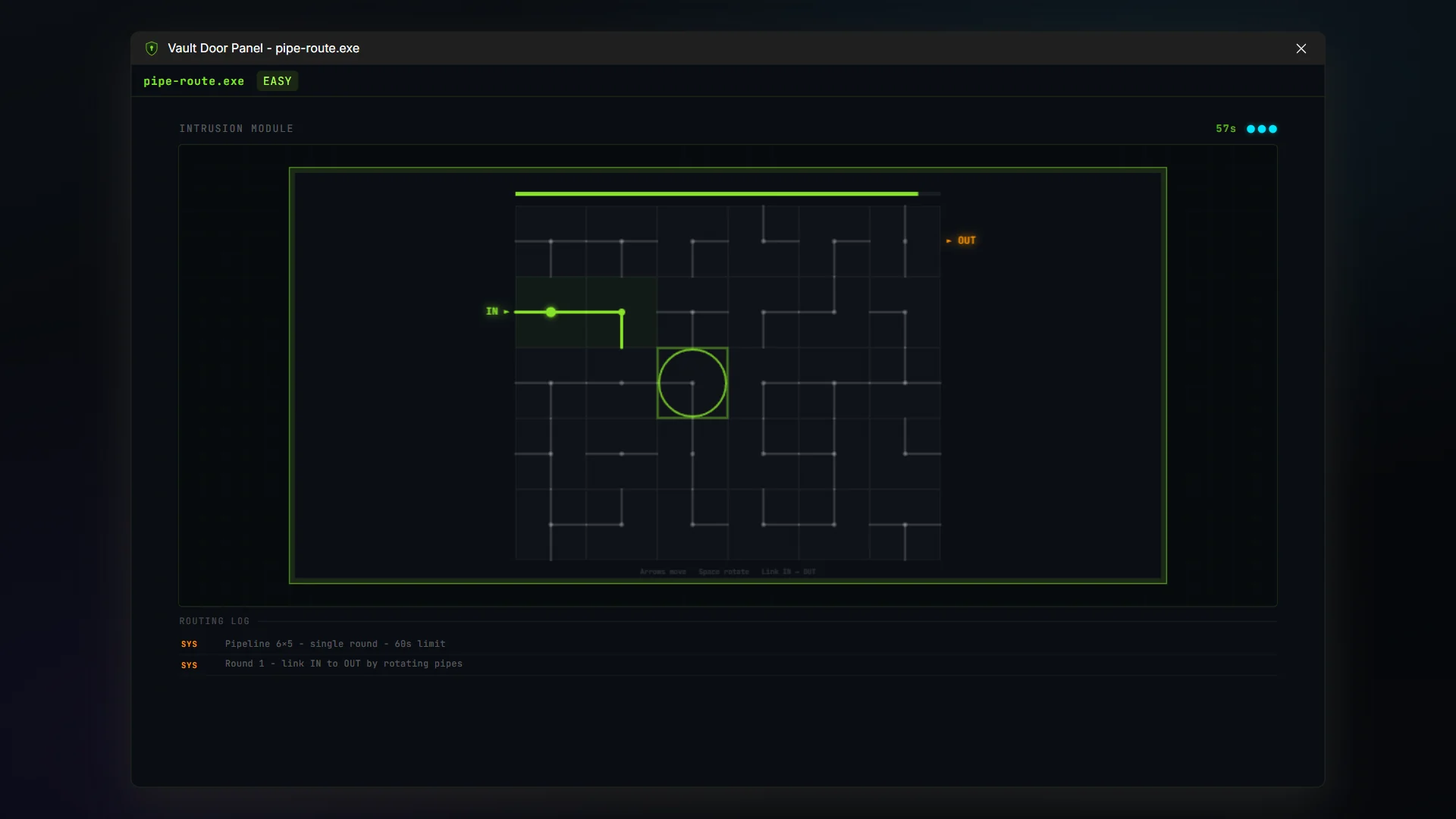
Example
-- client
local won, proof = exports['sd-computers']:StartHack({ game = 'pipe', difficulty = 'medium', title = 'Vault Door' })
if won then
    TriggerServerEvent('my-heist:server:openVault', proof)
end

-- server
RegisterNetEvent('my-heist:server:openVault', function(proof)
    local src = source
    local info = exports['sd-computers']:ConsumeHackProof(src, proof, { game = 'pipe', difficulty = 'medium' })
    if not info then return end -- no proof, someone else's, used, expired, or an easier run
    -- open the vault
end)
Never trust won on its own
won comes from the client. Always redeem the proof on the server before you give anything, or use RunHack, which does it for you.
A run from StartHack is not tied to a place: it proves the player won, not where they were. Check that on the server too. For swapping it into an existing robbery, and the other ways to use the minigames, see Hacks in Your Scripts.